Physical Address
304 North Cardinal St.
Dorchester Center, MA 02124

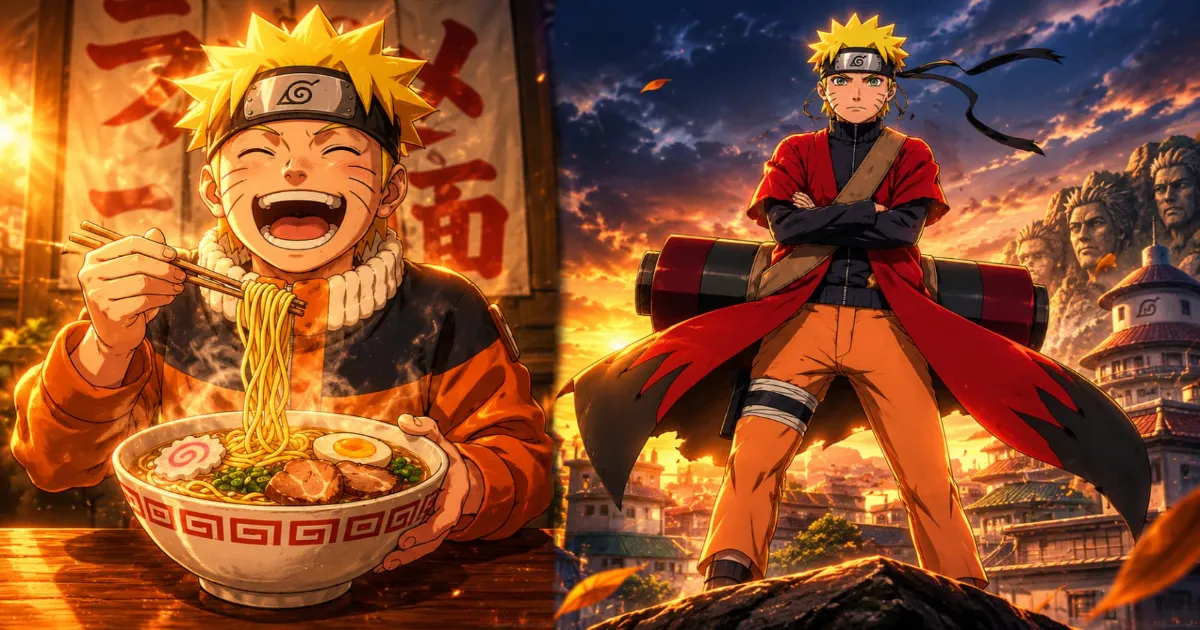
At first glance, Naruto vs Naruto Shippuden sounds like a comparison between two completely different anime series. In reality, they are two chapters of the same enormous story. Naruto introduces us to Naruto Uzumaki as a mischievous young ninja desperate to earn recognition, while Naruto Shippuden picks up several years later, when that same boy has returned from training and is beginning to understand what his dream of becoming Hokage actually demands.
The easiest way to understand the difference is to think of Naruto as the story of a child discovering the ninja world and Naruto Shippuden as the story of that child growing into one of its most important figures. The first series is about forming friendships, discovering abilities and surviving increasingly dangerous missions. Shippuden takes those same relationships and pushes them into much darker territory, where death, war, revenge and the fate of the entire shinobi world are at stake.
That change is what gives the two series such different identities, even though one directly continues the other.
Naruto: From Lonely Boy to the Seventh Hokage — His Complete Story Explained
Last Seen Official Trailer: Spoiler-Free Review of Apple TV’s New Mystery Thriller
The original Naruto begins with Naruto as a young Academy student in the Hidden Leaf Village. He is talented in some unusual ways but struggles with basic ninja techniques and has a reputation as a troublemaker. The reason for his isolation is the secret he doesn’t fully understand: the Nine-Tailed Fox, Kurama, was sealed inside him when he was a baby.
Naruto desperately wants to become Hokage because he believes the position will finally force the villagers to recognize him. His journey begins when he graduates from the Academy and joins Team 7 alongside Sasuke Uchiha and Sakura Haruno, with Kakashi Hatake as their teacher. Their early missions gradually introduce Naruto to the reality of being a shinobi, and the Land of Waves arc becomes his first major lesson in how complicated the ninja world can be.
From there, the story grows through the Chunin Exams, Orochimaru’s attack, the emergence of Gaara and the increasing tension surrounding Sasuke. Naruto begins to discover that being strong isn’t simply about learning techniques. It is about protecting people, making difficult choices and refusing to abandon those who matter to you.
The original series also establishes Naruto and Sasuke’s relationship as the emotional center of the story. They begin as rivals, but their rivalry slowly becomes something much deeper. Both are lonely, but they respond to that loneliness differently. Naruto tries to create bonds, while Sasuke increasingly believes that cutting himself away from others is the path to strength.
By the end of the original series, Sasuke has left the Hidden Leaf to pursue power, and Naruto has failed to bring him back. That failure becomes the emotional bridge between the two anime series.
This is where Naruto Shippuden begins.
After the original series, Naruto spends roughly two and a half years training with Jiraiya. When he returns to the Hidden Leaf, he is no longer the Academy student we knew at the beginning. He is older, stronger and more experienced, but he is still carrying the same promise to bring Sasuke home.
The difference is immediately noticeable. Naruto’s personality remains recognizable—he is still energetic, stubborn and optimistic—but his responsibilities have become much heavier. The enemies are stronger, the missions are more dangerous and the consequences of failure are far more serious.
The world has also changed during Naruto’s absence. The Akatsuki has become a major threat, hunting the tailed beasts and their jinchuriki. The organization introduces some of the most memorable villains in the entire franchise, including Itachi Uchiha, Deidara, Sasori, Kakuzu, Hidan, Kisame and eventually Pain.
This is one of the biggest differences between the two series. In Naruto, the characters are gradually discovering how dangerous the ninja world can be. In Shippuden, they are forced to confront the people and systems responsible for that danger.
The original Naruto has memorable villains, but many of Shippuden’s antagonists are built around philosophical questions rather than simply being powerful enemies.
Take Pain, for example. His real identity is Nagato, one of Jiraiya’s former students. Nagato believes that the world will never understand peace until everyone understands pain. His actions are horrifying, but his reasoning comes from years of war, loss and suffering.
Then there is Obito Uchiha, whose transformation is even more closely connected to Naruto. Obito was once a young shinobi who dreamed of becoming Hokage. He wanted recognition, cared about his teammates and believed in protecting others. After experiencing devastating loss, however, he became convinced that reality itself was not worth accepting.
Madara Uchiha takes the story even further. His conflict with Hashirama Senju reaches back to the founding of the Hidden Leaf and eventually becomes connected to the deepest history of the shinobi world.
The villains of Shippuden therefore aren’t simply obstacles for Naruto to defeat. Many of them represent possible paths Naruto himself could have taken.
That is one reason the second series feels considerably more mature.
The most obvious difference between Naruto and Naruto Shippuden is age.
In the original series, Naruto and his classmates are children. Their ambitions are still developing, their relationships are changing and many of their battles feel like the beginning of their lives as ninja.
Shippuden turns those children into young adults.
Naruto becomes more responsible. Sakura develops into an exceptionally capable medical ninja. Sasuke becomes increasingly consumed by his search for the truth about Itachi. Shikamaru grows from a lazy genius into a dependable leader. Hinata becomes more confident. Gaara transforms from a feared jinchuriki into the Kazekage and one of Naruto’s strongest allies.
The changes are not merely physical. Characters begin carrying the consequences of earlier decisions.
This is particularly important for Naruto himself. In the original series, he wants people to recognize him. In Shippuden, he begins understanding what it means to be responsible for other people’s lives.
His dream remains the same, but his understanding of that dream changes.
Their rivalry exists from the beginning, but Shippuden turns it into the central conflict of the entire narrative.
Sasuke’s obsession with killing Itachi eventually leads him to discover a devastating truth about the Uchiha clan. Instead of freeing him, that truth changes the target of his hatred. He begins questioning the Hidden Leaf itself and ultimately decides that the existing shinobi system needs to be destroyed.
Naruto, meanwhile, refuses to give up on him.
This creates one of the most important contrasts in the story. Sasuke believes peace can be achieved by taking control of hatred himself. Naruto believes peace requires people to understand one another and build genuine bonds.
Their final confrontation at the Valley of the End is therefore much more than a fight between two powerful ninja. It is the conclusion of an argument that began when they were children.
Naruto isn’t simply trying to defeat Sasuke.
He is trying to prove that Sasuke doesn’t have to remain alone.
Another major difference in Naruto vs Naruto Shippuden is the scale of the action.
The original series contains some excellent fights, including Naruto vs Neji, Rock Lee vs Gaara, Sasuke vs Gaara and Naruto vs Sasuke. But the battles are still mostly centered around individual ninja and relatively contained conflicts.
Shippuden dramatically expands the scale.
Naruto battles Pain across the destroyed Hidden Leaf. Sasuke confronts powerful Akatsuki members. The Five Great Shinobi Nations eventually unite during the Fourth Great Ninja War. Legendary figures are resurrected, massive chakra techniques reshape battlefields and Naruto and Sasuke eventually become involved in a conflict connected to the origins of chakra itself.
By the final stages of Shippuden, the story has moved far beyond the small-scale missions of the original series.
Naruto is no longer simply fighting to prove himself.
He is fighting to protect the entire world.
The original Naruto balances serious moments with plenty of comedy. Naruto’s pranks, Team 7’s arguments and the strange personalities of many supporting characters give the series a youthful energy.
Shippuden still has humor, but the emotional atmosphere becomes considerably heavier.
Characters die.
Villages are destroyed.
Families are torn apart.
The truth behind the Uchiha massacre is revealed.
Naruto loses Jiraiya.
The Fourth Great Ninja War puts almost the entire shinobi world at risk.
Even characters who survive are permanently changed by what happens to them.
This doesn’t mean Shippuden is simply darker for the sake of being dark. The heavier tone reflects the characters growing older. The story is no longer asking what these children want to become. It is asking what kind of adults they will become after everything they have experienced.
In the original series, most of the story revolves around the Hidden Leaf and the surrounding ninja villages. We learn about different clans, villages, missions and rivalries, but the world still feels relatively understandable.
Shippuden gradually reveals that the history of the shinobi world is much older and more complicated than anyone realized.
The Uchiha and Senju rivalry connects to the founding of the Hidden Leaf. The tailed beasts have their own history. The Sage of Six Paths becomes central to the story. The Otsutsuki connection introduces a much older layer of the Naruto mythology.
The story that began with Naruto wanting to become Hokage eventually becomes a battle over the future of the entire shinobi world.
That enormous expansion is perhaps the biggest difference between the two series.
The visual style also changes as the characters age.
The original Naruto has a distinctive early-2000s anime look, with simpler character designs and a strong emphasis on traditional ninja combat. Shippuden generally features more elaborate designs and larger-scale action sequences as the story progresses.
Some of the most visually memorable fights in the franchise occur during Shippuden, particularly Naruto’s battle with Pain and the later conflicts of the Fourth Great Ninja War.
However, the animation quality isn’t perfectly consistent throughout either series. Both contain episodes with exceptional animation and others that rely more heavily on simpler production.
The important difference is that Shippuden eventually has the opportunity to showcase abilities and battles on a much larger visual scale.
In the original series, Naruto’s abilities are relatively straightforward. He uses shadow clones, learns the Rasengan and gradually gains access to the Nine-Tails’ chakra.
Sasuke develops his Sharingan, Sakura improves her chakra control and the other young ninja establish their own techniques.
Shippuden expands the power system dramatically.
Naruto learns Sage Mode and eventually gains access to increasingly powerful forms connected to Kurama and the Six Paths. Sasuke’s Sharingan evolves into the Mangekyo Sharingan and later the Rinnegan. The story introduces more advanced Kekkei Genkai, powerful dojutsu, tailed beast transformations and increasingly complex chakra abilities.
The result is a dramatic escalation from the relatively grounded battles of early Naruto to the enormous confrontations seen near the end of Shippuden.
That depends on what you want from the series.
If you prefer character introductions, ninja missions, tournament-style battles and the feeling of watching young characters discover their abilities, the original Naruto may be more satisfying. Its early arcs have a strong sense of adventure, and the Chunin Exams remain one of the most celebrated portions of the franchise.
If you prefer emotional storytelling, complex villains, larger battles, character development and the history behind the shinobi world, Naruto Shippuden offers considerably more.
The two shouldn’t really be viewed as competitors.
The original series builds the foundation.
Shippuden builds the house.
Without the emotional groundwork established in the first series, many of Shippuden’s biggest moments would not have the same impact. Naruto’s determination to save Sasuke matters because we watched their friendship develop. Gaara’s transformation matters because we remember the lonely child he once was. Naruto’s relationship with Jiraiya matters because we saw how much his mentor meant to him.
Shippuden constantly pays off what the original series established.
| Feature | Naruto | Naruto Shippuden |
|---|---|---|
| Main Character | Young Naruto | Older Naruto |
| Setting | Early ninja journey | Larger shinobi world |
| Main Focus | Growth and friendship | War, peace, revenge and responsibility |
| Naruto’s Goal | Become Hokage and gain recognition | Protect his friends and achieve peace |
| Main Rival | Sasuke | Sasuke |
| Major Threats | Orochimaru and early enemies | Akatsuki, Obito, Madara and Kaguya |
| Tone | Youthful and adventurous | Darker and more mature |
| Power Scale | Relatively grounded | Extremely high |
| Major Conflict | Personal growth and Sasuke’s departure | Fourth Great Ninja War |
| Story Scope | Mainly village and regional conflicts | Entire shinobi world |
| Naruto’s Development | Academy student to young ninja | Young ninja to legendary shinobi |
Absolutely.
Although Naruto Shippuden is technically a continuation, watching the original series first makes the emotional moments far more powerful.
You need to see Naruto’s childhood before his return in Shippuden. You need to understand his friendship with Sasuke before their final confrontation. You need to experience Gaara’s transformation before seeing him as Kazekage. You need to meet Jiraiya before understanding what his death means to Naruto.
Most importantly, you need to see the lonely boy at the beginning before watching him eventually become the Seventh Hokage.
That transformation is the entire point of the story.
Ultimately, the difference between Naruto and Naruto Shippuden is not simply that one features younger characters and the other features older ones.
It is about what the story is asking.
Naruto asks: Who will these children become?
Naruto Shippuden asks: What will they do with everything they have become?
The first series is about Naruto finding his place in the world. The second is about him fighting to change that world.
He begins as the boy everyone ignores.
He becomes a teammate.
Then a friend.
Then a hero.
Then a leader.
And eventually, the Seventh Hokage.
That is why the two series work best as one continuous journey. Naruto is the beginning of the dream. Naruto Shippuden is the painful, spectacular and emotional road Naruto must travel before he can finally achieve it.
One story begins with a lonely ninja. The other ends with the Seventh Hokage.
And between those two versions of Naruto lies one of the most memorable journeys in anime.
Avengers: Doomsday Special Look Reveals Doctor Doom’s Tragedy