Physical Address
304 North Cardinal St.
Dorchester Center, MA 02124

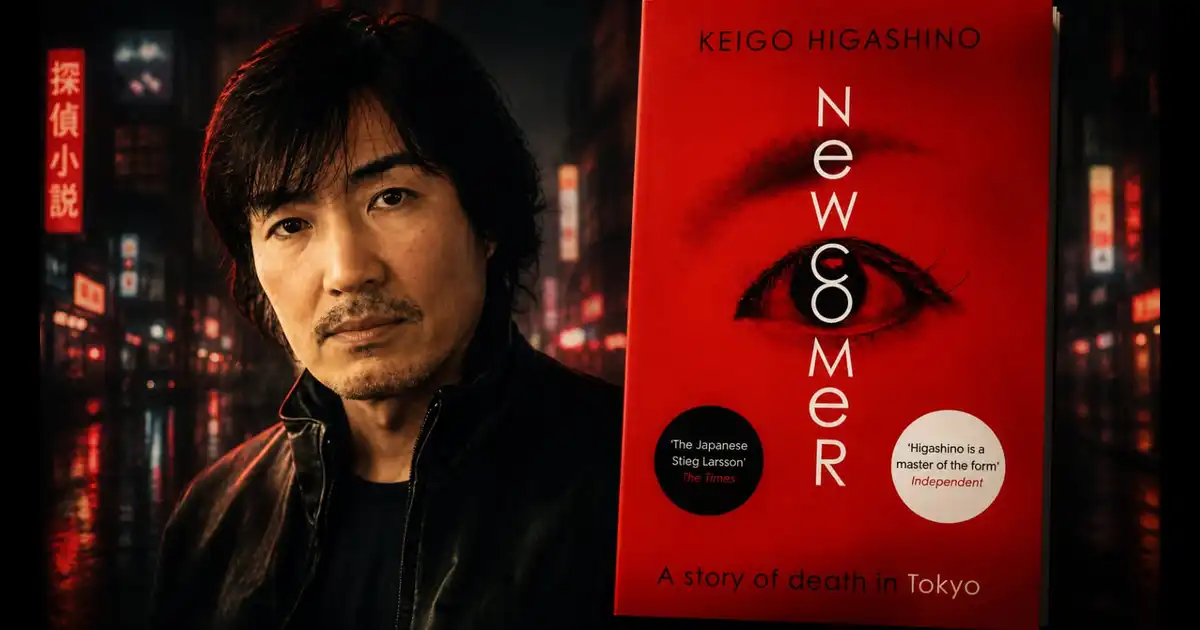
Most novelists spend their careers learning to write. Keigo Higashino spent his first five years as a novelist learning to solve problems, and it shows in every page he’s produced since. Born February 4, 1958, in Osaka’s working-class Ikuno ward, Higashino built a career that reads less like a typical literary biography and more like a case study in disciplined, methodical craftsmanship — the same qualities that define the physics-driven mysteries that made him one of the best-selling authors in the world.
Higashino’s background sets him apart from almost every other major figure in modern crime fiction. After graduating from Osaka Prefecture University with a bachelor’s degree in electrical engineering, he took a job at Nippon Denso — the company now known globally as DENSO — in 1981, working as an engineer while writing fiction in his spare time. That dual life continued for five years, and it left a permanent imprint on his writing style: strict internal logic, methodical plotting, and a fascination with how physical systems actually work, rather than the more atmospheric or psychologically driven approach many of his mystery-writing peers favored.Ryan Gosling Joins the MCU as Ghost Rider –Everything Announced at Comic-Con 2026
That engineering discipline eventually found its most famous fictional expression in Dr. Manabu Yukawa, the physics professor at the center of Higashino’s long-running Detective Galileo series — a character whose entire method of solving crimes mirrors the way Higashino himself was trained to think.
In 1985, at 27 years old, Higashino won the Edogawa Rampo Prize — Japan’s premier award for unpublished mystery fiction — for his debut novel Hōkago (After School), a story set in a high school and inspired by his own experience in his university’s archery club. The win gave him the confidence to make a genuinely risky decision: in 1986, he quit his engineering job entirely and relocated to Tokyo to write full-time, trading a stable career for the uncertain life of a working novelist.
The gamble took over a decade to fully pay off. Higashino spent the following years building a steady body of work, and in 1999 earned wider recognition when Himitsu (published in English as Naoko) won the Mystery Writers of Japan Award. The novel — about a father whose deceased wife’s consciousness appears to inhabit their surviving daughter’s body — was adapted into a Japanese film starring Ryoko Hirosue that same year, and later into a French remake in 2007. It remains one of his most acclaimed works, and reports have indicated filmmaker Luc Besson has been developing yet another adaptation.
If there’s a single turning point in Higashino’s career, it’s 2006’s The Devotion of Suspect X (Yōgisha X no Kenshin), the third entry in the Detective Galileo series. The novel had been nominated for the Naoki Prize — the Japanese equivalent of the National Book Award — five separate times across his career before finally winning it that year, alongside the Honkaku Mystery Award and a top-ten ranking in the influential “Mystery ga Sugoi!” critics’ poll, an unusually complete sweep of the country’s major genre honors in a single year.
The commercial numbers matched the critical reception. The Devotion of Suspect X sold more than 800,000 copies, making it the second-highest-selling book in Japan that year across both fiction and nonfiction. Its film adaptation spent four weeks atop the Japanese box office and finished as the third highest-grossing film of the year domestically. When the novel was translated into English, it earned nominations for both the Barry Award and the Edgar Award in 2012, introducing Higashino to an international mystery-reading audience that had largely overlooked him until that point.
Few working novelists anywhere have seen their work translated to screen as consistently as Higashino. By most tallies, close to twenty of his novels and story collections have been adapted into film or television, spanning multiple countries and languages. The Detective Galileo series alone has produced multiple feature films — Suspect X, The Midsummer Equation, and Witch of Laplace among them — alongside a long-running Japanese television drama. Journey Under the Midnight Sun (Byakuyako), one of his most acclaimed standalone novels, has been adapted into both film and television versions, including a TV drama starring Takayuki Yamada.
His international reach has grown substantially in recent years as well. The Devotion of Suspect X received a Chinese film adaptation in 2017 — the first time one of his novels had been adapted outside Japan — while Indian cinema has embraced his work with particular enthusiasm: Kolaigaran (2019) adapted Suspect X for Tamil audiences, Jaane Jaan (2023) brought the same novel to Hindi-language Bollywood, and Monica, O My Darling (2022) drew from his novel Burutasu no Shinzou. That level of adaptation activity, spanning Japanese, Chinese, Tamil and Hindi cinema within roughly a decade, reflects just how universally his particular blend of logical puzzle-construction and emotional restraint has translated across cultures.
Higashino’s trophy case reads as a near-complete sweep of Japan’s major literary honors: the Edogawa Rampo Prize (1985) for his debut, the Mystery Writers of Japan Award (1999) for Naoko, the Naoki Prize and Honkaku Mystery Award (both 2006) for The Devotion of Suspect X, the Shincho Prize (2008) for The Bond of Shooting Stars, the Chūōkōron Literary Prize (2012) for The Miracles of the Namiya General Store, and the Yoshikawa Eiji Literary Prize (2014) for When the Curtain Falls. He also received France’s Prix Polar International in 2010 for Mukashi Boku ga Shinda Ie, an early sign of the international recognition that would later follow The Devotion of Suspect X’s English translation. Beyond individual honors, Higashino served as the 13th President of the Mystery Writers of Japan from 2009 to 2013, a leadership role reflecting his standing among his peers as much as his readers.
Part of what makes Higashino’s international success notable is how specifically Japanese his sensibility remains even as his audience has globalized. He has described his own influences as rooted primarily in Japanese authors, particularly genre pioneers Edogawa Rampo and Seicho Matsumoto, and has spoken about wanting international readers to come away with a genuine understanding of “how Japanese people think, love, and feel” through his work — not a Westernized or diluted version of Japanese storytelling, but the real thing, made accessible through the universal mechanics of a well-constructed mystery.
That combination — rigorous, engineering-trained plotting paired with a specifically Japanese emotional register — is arguably the exact formula that has made his novels resonate so broadly, from Chinese bestseller lists (where he has been ranked among the top-earning foreign authors) to Bollywood adaptations to English-language crime fiction shelves. Few mystery writers working today can claim that level of genuine cross-cultural reach, and fewer still built the foundation for it in an engineering department rather than a creative writing program.
Keigo Higashino’s career defies the usual narrative arc of literary success — no early prodigy story, no MFA pedigree, just a working engineer who spent five patient years writing in his off-hours before finally earning the confidence to bet everything on fiction. Four decades later, that bet has produced one of the most adapted, most decorated, and most internationally translated bodies of mystery fiction to emerge from Japan in the modern era. For a writer whose signature protagonist solves crimes through physics, there’s a certain fitting symmetry to a career built the same way: methodically, logically, and with results that speak for themselves.