Physical Address
304 North Cardinal St.
Dorchester Center, MA 02124

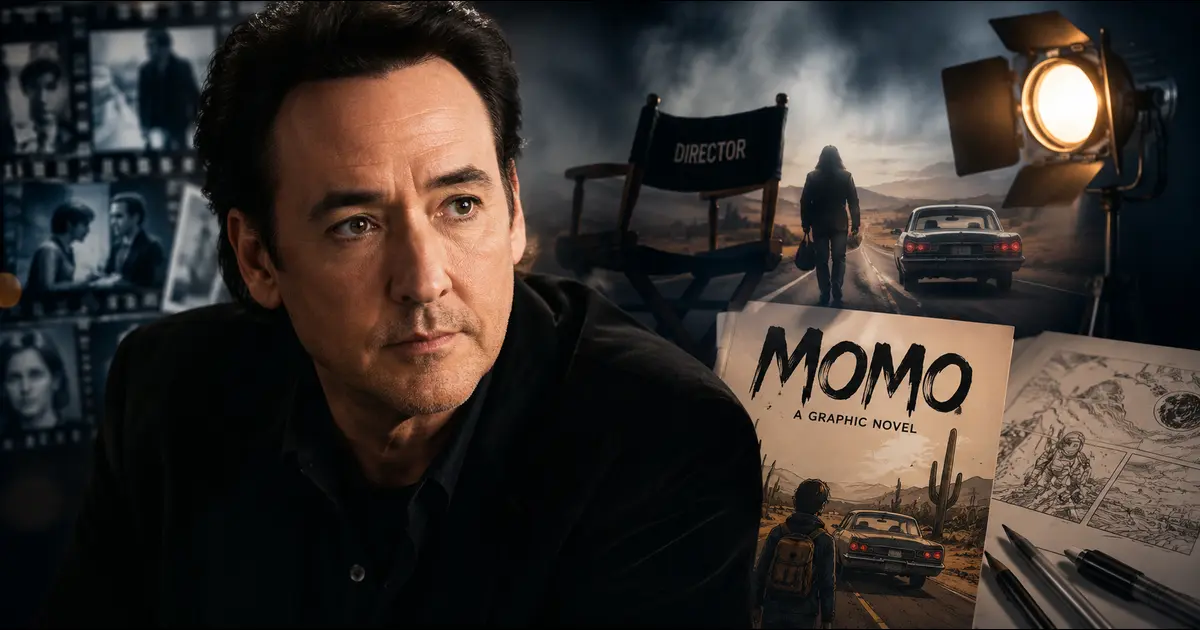
John Cusack doesn’t give many interviews these days, which is part of what made his recent conversation with Variety worth paying attention to. Ahead of an appearance at San Diego Comic-Con 2026, the 60-year-old actor sat down to discuss his upcoming graphic novel, Momo — and in the process, offered one of his most direct public explanations yet for why he pivoted away from film career work in favor of smaller, more independent projects.
Momo, described as a heist-and-road-trip story set in 1972 with an extraterrestrial twist, is a genuine passion project for Cusack, co-created with Argentine illustrator Ignacio Noé. What Cusack emphasized repeatedly in discussing it wasn’t the plot itself, but the process behind it — specifically, the total absence of anyone else’s input along the way. “Nobody edited anything I wrote or that he drew,” Cusack said of himself and Noé. “So it’s really a piece of work that was just done by two people.” Speaking with Just Jared around the same appearance, he put it even more simply: “It was just me and Ignacio’s story, and that doesn’t happen today.”The Odyssey Box Office Collection Worldwide, USA & India (2026) – Budget, Reviews & Ratings
That framing — two people, no committee, no notes — turns out to be the entire thesis behind his broader move away from studio filmmaking.
Cusack didn’t dance around the explanation when Variety pressed him on it. “I didn’t want to negotiate telling a story really,” he said. “When you ask somebody to put like $20 to $30 million into a bank account [for a film budget], they want to have an opinion, and they’re afraid and all that stuff.” For an actor who built his reputation on sharply written, distinctly voiced films, that description of modern studio financing — money attached to fear, and fear attached to committee-driven notes — reads less like a complaint and more like a diagnosis of an entire industry shift he watched happen in real time.
To Cusack, graphic novels have become “the closest thing to film” precisely because they let him retain the kind of directorial control a modern studio budget makes almost impossible to negotiate for. It’s a notable reframe: rather than treating comics and graphic novels as a step away from cinematic storytelling, Cusack described them as the closest available substitute for the version of filmmaking he actually wants to make.
What makes Cusack’s recent comments particularly credible is how consistent they are with what he was saying more than ten years earlier. Speaking to The Guardian back in 2014, Cusack described the specific studio system he came up under, name-checking his friend Joe Roth, who ran Disney until 2000. “He made things like The Rock and Con Air to make shareholders happy, but then he also gave six or seven slots to people he liked,” Cusack explained. “I got to make High Fidelity and Grosse Point Blank. Spike Lee got to make Summer of Sam. Wes Anderson got to make Rushmore. I had that memory of film and that’s gone.”
He went on to describe the shift in blunt arithmetic: what used to be a “one for you, one for them” system — a small number of commercial studio pictures subsidizing a small number of personal passion projects for favored directors and actors — has become, in his description, “six for them, with a committee cutting the film who weren’t part of making it, and maybe one for you.” A decade on, promoting an entirely independent graphic novel with no studio involvement at all, Cusack’s Comic-Con comments read like the logical endpoint of a frustration he’d been articulating in public for years.
The numbers back up the narrative. Cusack appeared in two films in 2025 — the thriller Fog of War and the Mandarin-language Detective Chinatown 1900, directed by Sicheng Chen and Mo Dai. Chen also directed Cusack’s sole film credit the year before, the war drama Decoded. Before that stretch, Cusack appeared in just one movie in 2022. Compare that pace to the actor who once anchored beloved studio and independent films alike throughout the 1980s, ’90s and 2000s — High Fidelity, Being John Malkovich, Serendipity, Con Air, 1408, Say Anything, and Grosse Pointe Blank all carry his name — and the shift in output is impossible to miss. It isn’t that Cusack stopped working; it’s that the specific kind of work he’s chosen has narrowed considerably, and increasingly moved outside the traditional studio pipeline entirely.
None of this is to suggest Cusack has vanished from public life altogether. Earlier this year, he made another rare public appearance at the 2026 Oscars, where he helped honor his late The Sure Thing director Rob Reiner — a reminder that Cusack’s retreat from frequent studio filmmaking hasn’t come with a retreat from the relationships and history that defined his career. The Comic-Con appearance to promote Momo represents a similar exception: a deliberate, occasional return to the public eye specifically in service of a project he actually controls, rather than a wholesale withdrawal from public life.
Cusack’s comments also arrive alongside a broader, if coincidental, pattern among his peers. His own sister, Joan Cusack, recently reflected in a separate interview with E! News on her own reduced acting output over the past decade, explaining that she made a deliberate choice to prioritize raising her children in Chicago over chasing additional film roles. Actor Antonio Banderas has described a similar recalibration following a near-fatal heart attack in 2019, after which he relocated back to his native Málaga, Spain, to focus on theater work he found more personally meaningful. “It changed the way I look at life,” Banderas told The Times earlier this year.
None of these stories are identical — Joan Cusack’s shift was about family priorities, Banderas’s about mortality, and John Cusack’s specifically about creative control and frustration with studio financing structures. But together they sketch a recognizable pattern among actors who reached a certain level of established success: a willingness, once financial pressure eases and reputation is secured, to trade volume of output for control over what actually gets made.
John Cusack’s explanation for stepping back from frequent studio filmmaking isn’t a dramatic falling-out or a retirement announcement — it’s closer to a considered response to an industry that changed shape around him over two decades. The “one for you, one for them” system he described benefiting from in the 1990s effectively subsidized personal, distinctive filmmaking with commercial hits; in his telling, that system has been replaced by one where committees dilute personal vision even in the rare slots still available for it. Graphic novels like Momo offer him an alternative that doesn’t ask him to make that trade. Whether or not that specific format becomes a lasting second act for him, Cusack’s rare public comments this week offer one of the clearest, most consistent explanations any actor of his generation has given for quietly opting out of the modern studio system altogether.