Physical Address
304 North Cardinal St.
Dorchester Center, MA 02124
Physical Address
304 North Cardinal St.
Dorchester Center, MA 02124

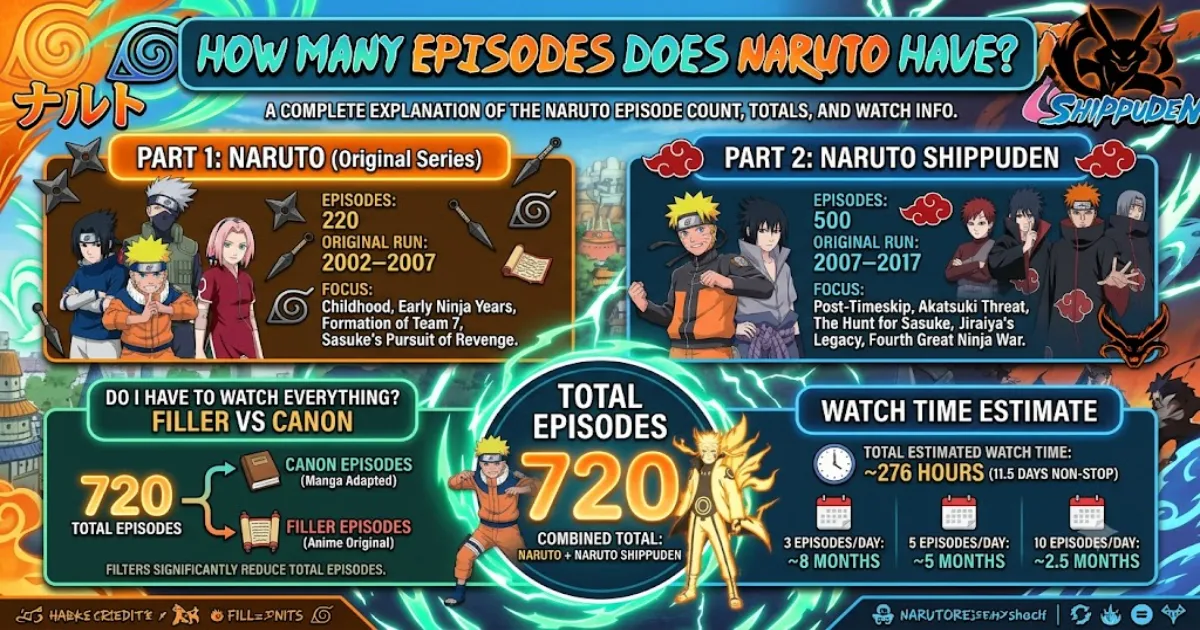
If you’re thinking about starting Naruto, there is one question that probably comes before almost everything else: how many episodes does Naruto have? The answer can look intimidating at first. The original Naruto anime has 220 episodes, while Naruto Shippuden continues the story with another 500 episodes. Together, the two main series contain 720 episodes.
That number explains why Naruto can feel less like a television show and more like a long journey. You’re not simply watching a protagonist complete a mission and move on to the next adventure. You’re watching Naruto Uzumaki grow from a lonely, mischievous Academy student into one of the most powerful and respected shinobi in the world. Along the way, friendships change, enemies become allies, dreams collapse, characters die and the entire ninja world is eventually pulled into war.
Naruto vs Naruto Shippuden: Every Major Difference Explained
But there is an important detail behind that 720-episode total: not every episode is part of the main manga story. Naruto contains a significant amount of filler, especially toward the end of the original series and throughout Shippuden. So if you’re planning your first watch, knowing the difference between the main story and filler can make the journey much easier.
The original Naruto aired for 220 episodes and follows Naruto’s journey from childhood through his early years as a ninja. This is where viewers meet Team 7, consisting of Naruto, Sasuke and Sakura under Kakashi’s leadership, and where many of the characters who later become central to the franchise are introduced.
The early episodes establish Naruto as an underdog. He struggles at the Academy, desperately wants to become Hokage and has almost no idea why the villagers treat him differently. His first missions slowly reveal that the shinobi world isn’t the simple world of heroes and villains he imagined. The Land of Waves introduces him to Zabuza and Haku, while the Chunin Exams introduce characters such as Gaara, Neji and Rock Lee.
As the story progresses, Naruto becomes stronger, but the emotional focus increasingly shifts toward Sasuke. Sasuke’s obsession with revenge against his brother Itachi eventually leads him away from the Hidden Leaf. Naruto’s attempt to stop him culminates in the first major battle between the two at the Valley of the End.
The original series ends with Naruto still determined to bring Sasuke back.
And that’s where the next chapter begins.
Naruto Shippuden continues the story after a time skip of roughly two and a half years. Naruto returns to the Hidden Leaf older, stronger and more experienced after training with Jiraiya.
The scale of the story immediately becomes larger.
The Akatsuki emerges as a major threat, targeting the tailed beasts and their jinchuriki. Gaara, who has become Kazekage, is captured by the organization. Naruto’s relationship with Sasuke becomes increasingly complicated, while the truth surrounding Itachi and the Uchiha clan slowly comes to light.
Shippuden contains 500 episodes, bringing the combined total of the two main Naruto anime series to 720 episodes.
These episodes take Naruto from his return to the village through some of the franchise’s biggest events: the Akatsuki conflict, Jiraiya’s death, Pain’s assault on the Hidden Leaf, Naruto’s mastery of Sage Mode, the Fourth Great Ninja War, Obito’s revelation, Madara’s return, Kaguya’s appearance and finally Naruto’s last battle with Sasuke.
By the end, Naruto is no longer the lonely child who simply wants people to notice him.
He has become the Seventh Hokage.
| Series | Episodes | Original Run |
|---|---|---|
| Naruto | 220 | 2002–2007 |
| Naruto Shippuden | 500 | 2007–2017 |
| Total | 720 | 2002–2017 |
So, if someone asks how many episodes does Naruto have, the simplest answer is 720 episodes across Naruto and Naruto Shippuden.
However, that doesn’t mean you necessarily have to watch all 720 episodes to experience the complete main story.
This is where the episode count becomes complicated.
Both Naruto series contain filler episodes and arcs that were not adapted directly from Masashi Kishimoto’s manga. Filler was often used because the anime was catching up with the manga and needed to create additional material rather than overtake the source material.
The original Naruto is particularly famous for its large amount of filler near the end. After the major story involving Sasuke’s departure, the anime spends a long stretch exploring additional missions and side stories before the series concludes.
Shippuden also contains numerous filler episodes and arcs. Some appear between major story events, while others temporarily take the anime away from the main narrative.
This doesn’t automatically make filler bad. Some filler episodes offer additional character moments, comedy or world-building. But if your goal is to experience Naruto’s main story as efficiently as possible, you can skip many of them.
There isn’t one universally agreed number for “canon episodes” because some episodes contain a mixture of manga material and anime-original content. Different watch guides also classify mixed episodes differently.
The safest way to think about it is that the 720-episode total includes everything that aired as part of Naruto and Naruto Shippuden, while a filler-free viewing order removes many anime-original episodes.
That distinction matters because someone watching all 720 episodes will have a noticeably different experience from someone following a strict manga-canon watch list.
If you’re watching Naruto for the first time, however, you shouldn’t feel pressured to race through it. Some viewers enjoy the slower pace because it allows the supporting cast to breathe and gives the world more room to develop.
One of the biggest surprises for new viewers is what happens after the major events of the original series.
The main story has reached a natural turning point after Sasuke leaves the village and Naruto makes his promise to bring him back. Instead of immediately moving into the next stage of the manga story, the anime spends a substantial portion of its remaining episodes on anime-original material.
This is why many first-time viewers eventually ask why the story suddenly feels different.
It isn’t because Naruto’s character has changed overnight.
The anime had caught up with the manga.
Rather than ending immediately, the television adaptation continued with additional stories until the next phase of the manga could provide enough material for the anime to continue.
Naruto Shippuden also has a lot of filler, but the situation is slightly different because the main story is much longer.
There are major stretches of canon material followed by anime-original stories, flashbacks and side adventures. Some filler arcs appear at moments when the main story has already reached an emotional climax, which can make the transition feel particularly abrupt.
For example, the Fourth Great Ninja War contains enormous amounts of story, but the anime also inserts flashbacks and side stories into the broader conflict.
For a first-time viewer, this can sometimes make the pacing feel strange.
A filler guide can therefore be extremely useful if your main priority is the central storyline.
No.
But whether you should is a different question.
If you want the complete anime experience, watching all 720 episodes allows you to experience the franchise as it originally aired, including its side stories, character moments and anime-original arcs.
If you mainly want Naruto’s core story, you can skip filler and significantly reduce the number of episodes.
The important thing is not to confuse “filler” with “bad.” Some anime-original episodes are entertaining, and some viewers genuinely enjoy the extra time spent with characters who receive less attention in the manga.
The best approach depends on what kind of viewer you are.
If you’re interested in the complete Naruto experience, watch everything.
If you’re interested in Naruto’s main journey, follow a reliable filler guide.
This is where the number 720 becomes truly intimidating.
A typical Naruto episode is around 23 minutes long, although the actual story content can be shorter once opening themes, endings and previews are included.
At roughly 23 minutes per episode, watching all 720 episodes would take approximately 276 hours, or around 11.5 days of continuous viewing without sleeping.
Of course, almost nobody watches Naruto that way.
If you watched three episodes a day, the complete 720-episode journey would take roughly eight months. At five episodes per day, you could finish in around five months. At ten episodes a day, you’re looking at roughly two and a half months.
And that’s without including the Naruto movies.
For most viewers, Naruto is better approached as a long-term journey rather than something to finish as quickly as possible.
The two series are directly connected.
Naruto follows Naruto and his friends during their younger years, focusing heavily on their introduction to the ninja world, their early missions, the Chunin Exams and Sasuke’s eventual departure.
Shippuden begins after the time skip and follows the characters as they grow into young adults. The story becomes darker and significantly larger, with the Akatsuki, the truth about the Uchiha clan, Pain, the Fourth Great Ninja War and the origins of the shinobi world becoming central to the plot.
In simple terms, Naruto is the beginning of the journey, while Shippuden is the journey reaching its enormous conclusion.
You should watch them in release order: Naruto first, followed by Naruto Shippuden.
The Naruto franchise also includes theatrical and animated movies, but the movies are not part of the 720-episode total.
The original Naruto and Naruto Shippuden are the main television series. The movies are additional releases that explore separate adventures or, in some cases, events connected more closely to the main continuity.
For a first-time viewer, the movies don’t need to be watched before starting Shippuden or inserted randomly into the series. If you want to watch them alongside the anime, it’s better to use a chronological movie guide so that you don’t encounter characters or abilities before they have been introduced in the main story.
The most important thing is to finish the main anime journey first if your priority is understanding Naruto’s central narrative.
The enormous episode count can look excessive compared with modern seasonal anime, but Naruto was produced during a different era of television anime.
Rather than releasing a short season and taking a long break, long-running anime such as Naruto typically aired continuously week after week.
That format allowed the story to spend considerable time with its characters.
Naruto doesn’t rush from one major battle to another. It spends time showing Naruto making friends, failing techniques, training, arguing with Sasuke, learning from Jiraiya and slowly becoming the person capable of carrying the hopes of an entire village.
The downside is pacing.
The same structure that gives Naruto its enormous world also creates long stretches of filler and repeated flashbacks.
That is why two people can watch “Naruto” and have completely different experiences depending on whether they watch every episode or follow a streamlined watch order.
For fans of character-driven shonen anime, absolutely—but with one important qualification.
Naruto is not a perfect 720-episode experience.
The pacing can be slow. Filler can interrupt major storylines. Flashbacks are sometimes repeated more often than necessary, and some anime-original arcs are much less important to the overall story.
But the payoff is enormous.
You watch Naruto go from the child nobody trusts to someone capable of uniting the shinobi world. You watch Sasuke struggle with revenge and eventually confront what his choices have cost him. You see Sakura grow from an inexperienced student into a formidable ninja. You watch Gaara’s transformation from a feared killer into a respected leader.
And because you’ve spent hundreds of episodes with these characters, their victories and losses carry weight.
When Naruto finally stands on the path toward becoming Hokage, you’re not simply watching the conclusion of an anime.
You’re watching the end of a journey that began hundreds of episodes earlier.
So, how many episodes does Naruto have?
The answer is straightforward:
Naruto — 220 episodes
Naruto Shippuden — 500 episodes
Combined total — 720 episodes
That figure does not include the Naruto movies, Boruto: Naruto Next Generations, OVAs or other spin-off material.
For someone standing at the beginning of this enormous franchise, 720 episodes might sound like an impossible commitment. But Naruto’s length is also part of its appeal. The story gives its characters time to grow, fail, change and surprise you.
You don’t simply meet Naruto and watch him become Hokage.
You grow up alongside him.
You see the lonely child become a teammate, the teammate become a protector, the protector become a hero and the hero eventually become the leader of the Hidden Leaf.
That is why the question “How many episodes does Naruto have?” has a much more interesting answer than simply saying “720.”
It means 720 episodes of Naruto’s journey from the boy nobody understood to the Seventh Hokage everyone could believe in.