Physical Address
304 North Cardinal St.
Dorchester Center, MA 02124

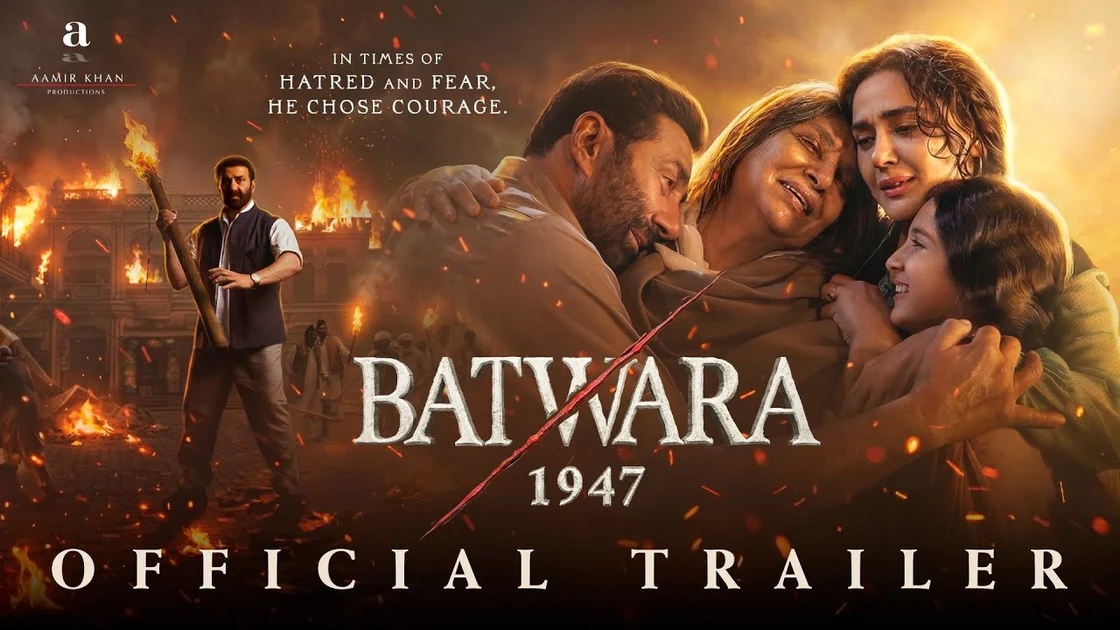
Some trailers sell spectacle. This one sells grief, and it does it unflinchingly. The Batwara 1947 trailer, released Tuesday, July 28, opens with the words “Bharat Mata Ki Jai” and closes on a note of quiet, hard-won hope — and in between, it makes an unmistakable case for one of the year’s most emotionally ambitious Hindi releases.
Batwara 1947 opens its trailer on a moment of celebration: Sunny Deol’s character, a Muslim man, congratulating his wife (Preity Zinta) on India’s newly won independence. That happiness curdles almost immediately. A voice in the crowd reminds him that the new India is being framed as a country for Hindus, and as communal riots spread, he comes to a devastating realization — the nation is about to split in two, and his family will have to leave for Pakistan. What follows in the trailer is Sunny Deol back in the kind of physically committed, protective-father mode that’s defined much of his career, fighting to get his family out safely as the Partition’s violence closes in around them.
The trailer’s real narrative turn arrives once the family reaches their destination: a haveli allotted to them that’s already occupied by a Hindu matriarch, played by Shabana Azmi, who refuses to simply vacate her ancestral home. That setup — two families, two faiths, one house, one shared historical catastrophe — is where the film’s actual emotional engine appears to live, and it’s a meaningfully different angle than a straightforward action-driven Partition drama would typically take.
Batwara 1947 is based on Asghar Wajahat’s acclaimed Hindi play Jis Lahore Nai Vekhya, O Jamya E Nai, which itself draws its title from a well-known Punjabi expression roughly translating to “one who hasn’t seen Lahore hasn’t truly lived.” The play has long been considered one of the more significant literary responses to Partition precisely because of its focus on ordinary domestic life disrupted by historical catastrophe, rather than battlefield-scale violence — a sensibility that appears to have carried directly into the film adaptation, based on what the trailer chooses to emphasize.
The project itself has had a notable journey to the screen. It was originally announced and shot under the title Lahore 1947, produced by Aamir Khan under his own production banner, before being retitled Batwara 1947 — a change the filmmakers have said better reflects the wider, more universal tragedy of Partition rather than anchoring the story to a single city’s name.
Director Rajkumar Santoshi, one of Hindi cinema’s most respected veteran filmmakers, returns to a genre — sweeping, socially conscious period drama — that has defined some of his best-regarded earlier work. He also wrote the screenplay, working from Wajahat’s original dialogues alongside his own additions. Behind the camera, cinematographer Santosh Sivan brings a résumé built on visually striking, historically grounded filmmaking, while the trailer’s score benefits from a soundtrack composed by A.R. Rahman, with lyrics from Javed Akhtar — a pairing whose earlier collaborations have produced some of Hindi cinema’s most enduring musical moments, and whose involvement here has already generated its own wave of anticipation independent of the film itself.
Beyond Deol, Azmi and Zinta, the cast includes Karan Deol, Ali Fazal and Abhimanyu Singh, giving the film a genuinely multi-generational ensemble to work with as it moves between the immediate trauma of displacement and its longer emotional aftermath. Aamir Khan’s involvement as producer adds another layer of expectation — his production banner has historically gravitated toward socially resonant, carefully researched projects, and Batwara 1947’s subject matter fits squarely within that tradition.
Batwara 1947 is scheduled for release on August 14, 2026 — Pakistan’s Independence Day, and the eve of India’s own Independence Day on August 15. That timing is clearly deliberate rather than coincidental, positioning the film directly within the annual moment when both nations collectively revisit the shared, painful history of their 1947 separation. Releasing a Partition drama during that specific weekend is as much a statement of intent as a marketing decision, and it raises the stakes for how the film will be received by audiences already primed to be thinking about this history at exactly that moment.
What the trailer does well is resist turning Partition into pure spectacle. The action beats are present — Sunny Deol’s fight sequences protecting his family are clearly going to be a marketed selling point — but the trailer consistently returns to smaller, quieter images: a shared home, a wary standoff between two women from different faiths forced into proximity, the specific texture of domestic loss rather than only battlefield-scale carnage. That’s a genuinely difficult balance to strike, and it’s the same balance that has made or broken nearly every major Partition drama Hindi cinema has attempted before it.
The risk is exactly the flip side of that ambition. A story built around restraint and quiet human drama needs every one of its big emotional swings to land cleanly, and with a starry, action-cinema-associated lead like Sunny Deol at the center, there’s an inherent tension between what the marketing will likely lean on to sell tickets and what the film’s source material suggests it actually wants to be. The trailer threads that needle better than most recent comparable attempts — but the full film will be the real test of whether that balance holds for two-plus hours.
On the strength of this first look, Batwara 1947 has assembled genuinely formidable talent both in front of and behind the camera, working from source material with real literary and historical weight, releasing at exactly the moment in the calendar built to maximize its emotional resonance. It’s easily one of the most anticipated Hindi releases of the back half of the year, and the trailer alone — evocative visuals, a clearly personal Rahman score, and a premise that finds something genuinely fresh to say about a historical tragedy Hindi cinema has revisited many times before — suggests Aamir Khan’s production instincts haven’t dulled. Whether the finished film delivers on that promise arrives August 14.






[…] Batwara 1947 Trailer Review: Sunny Deol Leads a Stirring Partition Tale […]