Physical Address
304 North Cardinal St.
Dorchester Center, MA 02124
Physical Address
304 North Cardinal St.
Dorchester Center, MA 02124

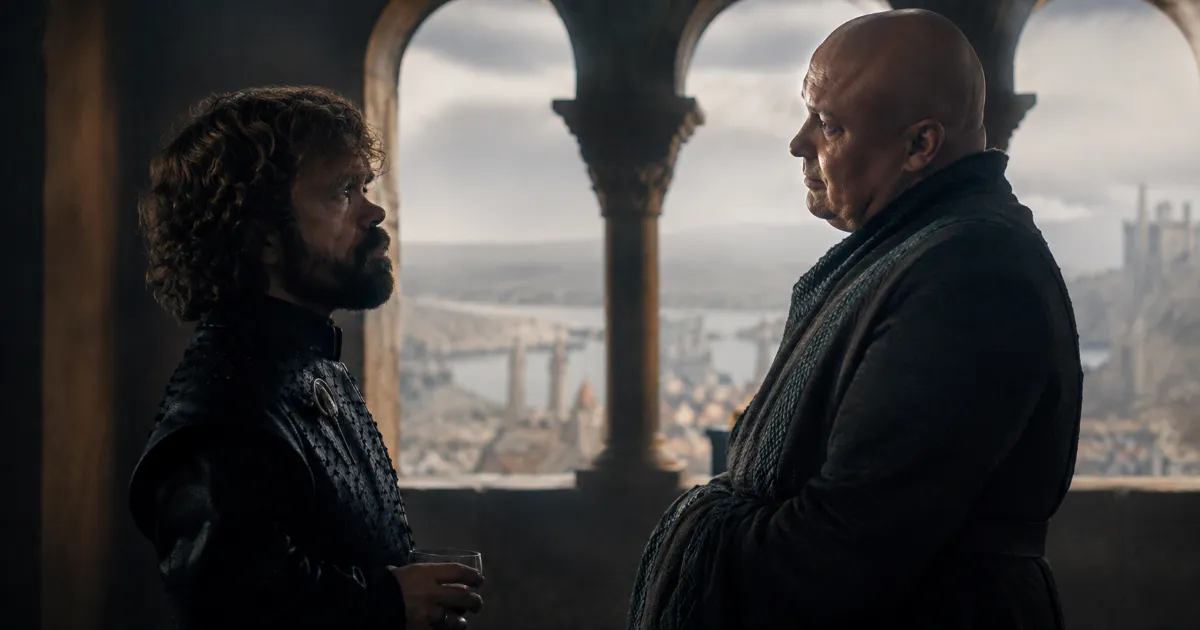
“Thoughts aren’t treason” comes from Season 8, Episode 4, “The Last of the Starks,” spoken by Tyrion Lannister to Varys — and it’s one of the most quietly loaded exchanges of the show’s final season. Jon Snow has just learned he’s actually Aegon Targaryen, with a stronger bloodline claim to the Iron Throne than Daenerys, his queen and lover. Varys, ever the political survivor obsessed with finding the best ruler rather than the one with the strongest claim, starts probing Tyrion about whether Jon might make a better king than Daenerys. Tyrion initially deflects, pointing out that Jon already proved his lack of ambition by bending the knee the moment he learned the truth. When Varys presses further — “Don’t pretend you haven’t thought about it” — Tyrion’s guarded response cracks: “We’re discussing treason.” Varys refuses to let him off that easily, and Tyrion finally admits it outright: he has thought about it, but privately entertaining a disloyal idea and actually acting on it are two very different moral categories.Guide Movie Review: Why Dev Anand’s 1965 Masterpiece Is Still a Cult Classic
The line matters because of what it sets up. This exchange is the first real signal that two of Daenerys’s most trusted advisors are beginning to quietly lose faith in her — a doubt that proves tragically justified just a few episodes later, when Daenerys burns King’s Landing to the ground. Along with this scene, a few of the show’s other most enduring lines say just as much about Game of Thrones as a whole than their brevity might suggest.Ryan Gosling Joins the MCU as Ghost Rider –Everything Announced at Comic-Con 2026
The full exchange is worth sitting with, because the tension in it is entirely about what each man is willing to say out loud versus what he’s actually thinking. Varys frames his argument in almost clinically political terms, telling Tyrion that Jon is “temperate, and measured” and — pointedly — “a man,” which he argues makes Jon more palatable to the Lords of Westeros whose support the Targaryen cause will need. Tyrion, still nominally loyal to Daenerys as her Hand, tries to shut the conversation down before it becomes an actual conspiracy. His line draws a hard, deliberate distinction: thought is not yet action, and admitting a doubt is not the same as committing treason. It’s one of the more quietly devastating moments in the back half of the show, because both men are right to be worried, and neither of them do enough about it before it’s too late.
 Spoken by Cersei Lannister in the very same episode, this line has become the closest thing the show has to a mission statement, and it’s easy to see why. Cersei delivers it to Ned as a warning, explicitly rejecting the idea that political conflict in Westeros allows for compromise, retirement, or graceful exits — you either hold power completely, or you lose everything, including your life. It’s a philosophy the show spends its entire run testing, and one that Cersei herself embodies right up to the final season, refusing to yield the throne even as her position collapses around her. The line endures because it distills the entire show’s central tension — honor versus survival — into a single, chilling sentence.
Long before Ned Stark ever sits the Iron Throne’s shadow in King’s Landing, he teaches his son Bran this lesson in Winterfell’s very first scenes, explaining why he personally executes a deserter from the Night’s Watch rather than delegating the act to someone else. The philosophy behind it is simple but foundational to Ned’s entire character: if you’re going to pass a sentence of death, you owe it to the condemned — and to yourself — to carry it out personally, rather than distancing yourself from the consequences of your own authority. It’s a quietly radical idea for a fantasy series built around kings and lords, and it sets up one of the show’s most devastating pieces of dramatic irony: Ned’s own execution later comes at the hands of a executioner acting on someone else’s order, precisely the kind of detached, consequence-free killing he warned Bran against.
Tywin Lannister delivers this line to Tyrion during Season 3, framing it as a hard lesson about how power actually functions in Westeros — family unity and discipline, in Tywin’s view, will always outlast individual ambition or desire. It’s a genuinely persuasive piece of political philosophy on the surface, and it’s also almost immediately undercut by Tyrion’s own sharp reply, pointing out how conveniently that philosophy always seems to justify whatever Tywin himself already wants to do. The exchange captures something the show returns to again and again: powerful characters dressing up self-interest as timeless wisdom, and the show trusting its audience to notice the gap between the two.
What connects all of these quotes is that none of them work as isolated one-liners. Each one is inseparable from the specific power struggle, betrayal, or moral test happening on screen at that exact moment — Tyrion and Varys’s dangerous flirtation with disloyalty, Cersei’s ruthless survival instinct, a father teaching his son about the weight of authority, a patriarch justifying cruelty as wisdom. That’s the real reason Game of Thrones quotes have outlasted the show’s divisive final season in the broader cultural conversation: they were never written as slogans. They were written as character, and character tends to stick around long after audiences stop debating how a particular season ended.